The Official Publication of Volunteer Youth Leaders for Health - Philippines

  • Youth for Health

    VYLH-Philippines is a network of pro-active, service-oriented youth leaders and youth organizations linked by the common interest of volunteerism and public service, to improve birth outcomes through advocacy.

  • Promoting Volunteerism

    VYLH-Philippines is a network of pro-active, service-oriented youth leaders and youth organizations linked by the common interest of volunteerism and public service, to improve birth outcomes through advocacy.

  • A Culture of Concern and Commitment

    VYLH-Philippines is a network of pro-active, service-oriented youth leaders and youth organizations linked by the common interest of volunteerism and public service, to improve birth outcomes through advocacy.

  • Moving towards the Communities

    VYLH-Philippines is a network of pro-active, service-oriented youth leaders and youth organizations linked by the common interest of volunteerism and public service, to improve birth outcomes through advocacy.

  • Glocal and Proud to be Filipino

    VYLH-Philippines is a network of pro-active, service-oriented youth leaders and youth organizations linked by the common interest of volunteerism and public service, to improve birth outcomes through advocacy.

DOH CALABARZON, VYLH hold Regional Youth Camp for TEENdig youth

NASUGBU - The Newborn Screening Program of the Department of Health (DOH) – Center for Health Development – CALABARZON (Region IV-A), in collaboration with Institute of Human Genetics - National Institutes of Health, University of the Philippines Manila (IHG-NIH, UPM), and Volunteer Youth Leaders for Health-Philippines (VYLH-Philippines), organized a regional youth camp with the theme “SIKLAB: Igniting Passion for Service and Health” on April 28-30, 2026.

The activity aimed to empower and mobilize volunteer youth leaders in the region to promote awareness on expanded newborn screening, preconception care, folic acid supplementation in the prevention of birth defects, and public support for rare diseases. 


The program included advocacy lectures, leadership workshops, community engagement planning, and team-building activities to strengthen the values of cooperation, responsibility, and active youth participation for health.


The majority of the participants were youth leaders identified by school administrators and  TEENdig facilities. TEENdig Kabataan is a flagship adolescent health program launched by DOH CaLaBaRZon to empower youth, particularly against teenage pregnancy, HIV, and mental health issues. It establishes safe-space youth centers in local schools and communities where teens can access peer navigators, health consultations, and psychosocial support.


Day 1 | 28 April 2026


In her message, National Scientist Carmencita Padilla, National Adviser of VYLH-Philippines, welcomed the participants for joining the youth camp. She also emphasized the benefits and positive impact of volunteerism on oneself and the community. In particular, she highlighted the role of volunteers as partners of specialists and health professionals in spreading awareness about newborn screening. Ms. Jeanne Ruth Basas, VYLH-Philippines Vice President for NCR-South Luzon, and Ms. Aster Lynn Sur, National Secretariat, also gave a brief message to the participants.


Dr. Monica Stephanie Moreno, Medical Officer III of DOH CALABARZON, presented an overview of the national and regional health situation. One of the key developments that she highlighted is the decline in adolescent and teenage pregnancy, which the region continuously aspires to deter. She also introduced the TEENdig Centers of the region, which aim to provide school-based, adolescent-friendly health services and address issues such as teen pregnancy, HIV, and mental health. 


Mr. Rufus Thomas Adducul, VYLH-Philippines President, presented an overview of VYLH-Philippines youth network, its advocacies, and activities. On the other hand, the first advocacy of VYLH-Philippines presented during the camp was preconception health. Ms. Kevina Mariz Dajoyag, University Researcher I at the Center of Human Genetics Services, IHG-NIH, UPM, gave an overview of the topic through the LINC framework, which covers Healthy Lifestyle, Infection Prevention, Proper Nutrition, and Contraception and Family Planning. 


In the evening, the participants wearing their “2000’s internet aesthetic attire” gathered for a night of socialization and talent. Teams were also represented for the Search for Mr. and Ms. Siklab.


Day 2 | 29 April 2026


The second day of the camp started with a message from Dr. Mark Nicholas Santos, Cluster Head of the Family Health Unit of DOH CaLaBaRZon. He reminded the participants that while pressure on their shoulders is overwhelming, their impact and contribution weigh more for the good of their community and the country


During the morning session, the participants were introduced to the various advocacies of VYLH-Philippines, namely supporting newborn screening promotion, rallying public support to rare disease patients, and promoting folic acid awareness. 


  • Newborn screening was introduced by Ms. Jane Delfin, Nurse II, Center for Human Genetics Services (Visayas), IHG-NIH, UPM. The presentation was followed by the regional updates on newborn screening coverage and initiatives from DOH CaLaBaRZon as presented by Mr. Jose Antonio Yap, Regional Newborn Screening Nurse Coordinator.

  • An overview of rare diseases was presented by Ms. Aster Lynn Sur, VYLH-Philippines National Secretariat and former Project Development Officer of the Center for Human Genetic Services, IHG-NIH, UPM. She also introduced the Global Nursing Network for Rare Diseases (GNNRD), which brings together nurses from across the world, building capacity through connectedness, awareness, education, leadership, and advocacy to support people and families living with a rare disease.

  • The topic of birth defects was introduced by Ms. Mica Caballes of VYLH-Philippines Batch Sibol through the “Baby Making 101” activity. This was followed by the presentation delivered by Ms. Irish Alysa Herlao, Nurse II, Center for Human Genetics Services, IHG-UPM. 


In the afternoon, the discussion focused on advocacy implementation and leadership. Mr. Ryan John Pascual, former National President of VYLH-Philippines gave tips on creating and strategizing impactful advocacy campaigns. On the other hand, Mr. Christian Emmanuel Enriquez, Immediate Past President of the VYLH-Philippines, inspired the participants by sharing her volunteer journey and her thoughts on leadership. 


As an opportunity to ignite action, the participants grouped into their respective provinces strategized and discussed their initial plans for the coming school year. This was followed by the plenary presentation of plans and critique.


After dinner, the camp team building commenced with the presentation of banners and cheers from each group. Various activities were prepared for the activity which each station marked by the festivities of the region. From chaos to proper communication and laughter-filled moments, the team building reminded the participants that leadership is stronger when they work as one.


The team building concluded with a synthesis facilitated by Mr. Ramonito Nuique. During the session, stories were shared, lessons were learned, and purpose became clearer: to grow not just as individuals, but as a community of leaders committed to a meaningful impact.

And as the journey deepened, the participants gathered around a bonfire and took their pledge of commitment as new VYLH-Philippines volunteers and TEENdig Youth. Each voice that said “𝐘𝐄𝐒” carried a promise—𝐭𝐨 𝐬𝐞𝐫𝐯𝐞, 𝐭𝐨 𝐥𝐞𝐚𝐝, 𝐚𝐧𝐝 𝐭𝐨 𝐜𝐫𝐞𝐚𝐭𝐞 a 𝐜𝐡𝐚𝐧𝐠𝐞 𝐛𝐞𝐲𝐨𝐧𝐝 𝐭𝐡𝐞𝐦𝐬𝐞𝐥𝐯𝐞𝐬 and towards healthier communities.


Day 3 | 30 April 2026


On the final day of the camp, the day started with the election of a batch representative and provincial coordinators. This was followed by the cultural presentations by each provincial group. As announced, a follow-up meeting by the NCR-SL leadership will be organized on the plans prepared by each provincial group. 


The camp concluded with the awarding of certificates, volunteer pins, and the distribution of promotional materials to the volunteers. Each pin placed to each volunteer carried a deeper meaning—𝐚 𝐜𝐨𝐦𝐦𝐢𝐭𝐦𝐞𝐧𝐭 𝐭𝐨 𝐥𝐞𝐚𝐝, 𝐬𝐞𝐫𝐯𝐞, 𝐚𝐧𝐝 𝐢𝐠𝐧𝐢𝐭𝐞 𝐜𝐡𝐚𝐧𝐠𝐞 𝐢𝐧 𝐨𝐮𝐫 𝐜𝐨𝐦𝐦𝐮𝐧𝐢𝐭𝐢𝐞𝐬. Volunteers were also recognized through the Kalog awards, which made the event more memorable.


Regional and Provincial Representatives of VYLH-Philippines Batch Siklab


Share:

VYLH, youth orgs support mandatory fortification of wheat flour with folic acid

The Volunteer Youth Leaders for Health-Philippines, together with 33 youth organizations and formations, signified their support for the mandatory fortification of wheat flour with folic acid. Collectively, the youth organizations represent more than 7,000 youth leaders and members in various universities and communities across the country. 


The youth statement was made in support of the campaign led by the Spina Bifida Support Group Foundation, Inc., and its technical partners, namely the Food Fortification Initiative and Nutrition International.  Several professional societies have also joined the campaign calling for the National Nutrition Council Governing Board to approve the Resolution for folic acid fortification of wheat flour:

  • Philippine Association of Nutrition, Inc.
  • Pediatric Nephrology Society of the Philippines
  • Philippine Society of Pediatric Urology
  • Philippine Pediatric Society
  • InkluNasyon (PCUNCRPD, E-Net Philippines, LAPIS-Seesaw Channel, NORFIL Foundation, Inc)
  • Academy of Filipino Neurosurgeons
  • Asian Australasian Society for Pediatric Neurosurgery
  • International Society for Pediatric Neurosurgery
  • Philippine Obstetrical and Gynecological Society (Foundation), Inc.

In addition to the call for flour fortification, the youth statement also mentioned the need to "ensure public access to folic acid supplements and increase awareness on the importance of dietary folate and folic acid supplementation to complement food fortification." 

Overall, these interventions are geared towards the prevention of neural tube defects and improvement of birth outcomes, as well as the development of health-seeking behavior among the youth and Filipinos of reproductive age.

The following are the youth organizations that signified their support for the youth statement:

Volunteer Youth Leaders for Health-Philippines
#FolicacidPH, National Social media Day and Youth Campaign for Folic acid Awareness
VYLH Father Saturnino Urios University
K4Health - VYLH Calapan City

National Youth Organization/Formation
Asian Medical Students Association - Philippines

University-based Youth Organizations
Alliance of Nationalist Doctors - Bicol University College of Medicine
Asian Medical Students Association - St. Luke’s Medical Center College of Medicine
Cavite State University - The Asclepian Society
Health Sciences Society of the Ateneo (Ateneo de Manila)
Microbia (West Visayas State University)
Order of Asclepius (West Visayas State University)
Palawan State University School of Medicine Student Council
Philippine Association of Nutrition - Alpha Chapter (UP Diliman)
Philippine Association of Nutrition - Alpha Omega Chapter (UP Los Baños)
Philippine Association of Nutrition - Beta Zeta Chapter (Benguet State University)
Philippine Association of Nutrition – Phi Sigma Upsilon Chapter (Partido State University)
Silliman University Student Government Health Committee
Pre-Medical Society of the Ateneo - Senior High School (Ateneo de Manila)
St. Anthony's College - Nursing Department (Antique)
St. Luke's Medicine Student Council -  St. Luke’s Medical Center College of Medicine
The UPLB Genetics Society (UP Los Baños)
UP Film Circle (UP Los Baños)
UP Medicine Student Council (UP Manila)
UPV PH Pub (UP Visayas)

Community-based Youth Organizations
Abra Youth Organizations Society
Active Leaders and Peer Advocates for Greater Adolescent Health Development (Region VII)
Association of Dynamic Medics (Metro Manila)
Baseco Youth Cares Organization
Cebu Coalition of Student Councils
LeadUp Youth Alliance (Cebu)
Rotaract Club of Midtown Butuan - CSU Chapter (Butuan City)
Rotaract Club of Padre Garcia (Batangas)
Rotaract Club of San Pablo City (Laguna)
United Young Leaders Coalition (Region VII)
Youth Alliance for Community Care, Environmental Sensitivity, and Sustainability (Albay)

Read the full statement. (RPPascual)

Share:

Dumaguete Steps Up in Powerful Run for Rare Disease Awareness


 by Zecariah Chito A. Jumawan 


Dumaguete City, Philippines – A wave of community spirit swept through Dumaguete City on March 1, 2025, as over 959 runners participated in the VYLH-Philippines Run for Rare Disease. Organized by the dedicated Volunteer Youth Leaders for Health – Philippines Dumaguete Members, the event aimed to illuminate the often-overlooked issue of rare diseases in the Philippines.

Under the expert guidance of Mr. Floyd Edrea and in strong partnership with the Dumaguete City Health Office and the Dumaguete City Sports Office, the event was a resounding success. The streets of Dumaguete pulsed with energy as participants of all ages, from an enthusiastic two-year-old to an inspiring 79-year-old, demonstrated their unwavering commitment to the cause.

A diverse and passionate crowd rallied for the cause, drawing strong support from local businesses, government agencies, and talented individuals. New Bian Yek Commercial, Inc. led the way by sponsoring 75 runners, while Negros Oriental Provincial Hospital and Negros Oriental Police Provincial contributed 24 and 21 runners, respectively, significantly amplifying the event’s impact. Skilled photographers and videographers from Dumaguete City generously volunteered their time to capture the event, ensuring the message of rare disease awareness resonated far beyond the finish line.

The event was further elevated by the presence of Dr. Ebner Bon G. Maceda, unit head of the Clinical Genetics & Research Unit of the University of the Philippines Manila. His presence, alongside VYLH-Philippines members from Luzon and Cebu, underscored the national significance of the event.

The VYLH-Philippines Run for Rare Disease stands as a powerful testament to the strength of community and the critical importance of raising awareness for rare diseases. Part of the proceeds from the run will be directly donated to the identified families in Negros Oriental with children affected by rare diseases, providing essential support to those facing the unique challenges associated with these conditions.

The organizers expressed their sincere gratitude to all the participants, sponsors, volunteers, and the LGU of Dumaguete City for their invaluable contributions to the event’s triumph. The overwhelming response highlighted the growing awareness and unwavering commitment to supporting those living with rare diseases in the Philippines.


For updates, follow Care for Rare Dumaguete City in Facebook


Share:

DOH Western Visayas CHD Mobilizes Youth Leaders for NBS Advocacy


NEGROS OCCIDENTAL - The Newborn Screening (NBS) partners and stakeholders in Western Visayas value the essential role of the youth in nation-building and promoting health and well-being because the YOUTH can!

With its persistent efforts in ensuring screening of all newborns for NBS disorders, the Department of Health Western Visayas Center for Health Development conducted a VYLH-Philippines Visayas Cluster Camp: Shaping the Next Generation of Health Champions last Sept. 27- 29, 2024 at the Nature’s Village Resort, Talisay City, Negros Occidental. 

Held in collaboration with the Newborn Screening Center Visayas and Volunteer Youth Leaders for Health-Philippines, the activity aimed to provide potential youth advocates with the necessary information to effectively disseminate and advocate the NBS program. Forty-four (44) youth leaders (15-30 years old) from various universities and community-based youth organizations from the different island groups of Panay-Guimaras, Negros Occidental, Negros Oriental, and Mindoro participated in the three-day activity and were given the batch name, Salinlahi.

As a commitment to the network, Batch Salinlahi discussed various school and community-based advocacy activities in support of campaign implementation during the regional planning session, including basic IEC campaign activities, advocacy lectures, etc.

The Volunteer Youth Leaders for Health-Philippines is a network of proactive, service-oriented, and empowered visionary leaders equipped with knowledge and skills to mobilize the youth toward addressing health issues. 

Currently, the network has four (4) advocacies: NBS program, folic acid supplementation, preconception health, and rare disease/orphan disorders. FMODeaño 

_______________
First published in Newborn Screening Vol 25 No. (2024) 

Share:

UP Manila joins worldwide initiatives for birth defects and rare diseases


MANILA - In celebration of the 5th World Birth Defects Day, the March of Dimes (MOD) together with World Health Organization (WHO) and the US Centers for Disease Control and Prevention (US CDC) organized a webinar entitled: “Saving Lives of Babies with Birth Defects and Improving their Quality of Life” last March 03, 2021 (CET).

This webinar aimed to promote quality of care and universal health coverage for children with birth defects and to bring to light different perspectives and the need for this advocacy. Among the panelists was Dr. Carmencita D. Padilla, Professor of Pediatrics, Chancellor of the University of the Philippines Manila, where she shared the success story of the newborn screening program of the country.


After the webinar, MOD hosted a twitter chat that fostered important virtual discussions with various organizations from all over the world. The Volunteer Youth Leaders for Health – Philippines whose advocacy includes the promotion of folic acid in the prevention of birth defects, participated actively in this unique event.


Dr. Padilla also attended the Rare Disease Day Policy event, a Call for a UN Resolution on Persons Living with a Rare Disease, "Why a UN Resolution and Why Now" on March 3, 2021 (CET). The overarching goal of the event is to position persons living with a rare disease (PLWRD) as a priority population in need of global and national policies that address their needs and contribute to achieving the UN 2030 Agenda, the Sustainable Development Goals and their pledge to ‘leave no one behind’. At this event, the proposal from the rare disease civil society community, with the support of a number of UN Member States, is to adopt a UN General Assembly Resolution that can act as a catalyst towards this goal.#

WATCH: Rare Disease Day Policy Event, a Call for a UN Resolution


Published in the UP Manila Newsletter HealthScape
Special COVID-19 Issue No. 25 (15 March 2021)
Published by the UP Manila - Information, Publication, and
Public Affairs Office (IPPAO)


Share:

Government and Academe Focus on Rare Diseases

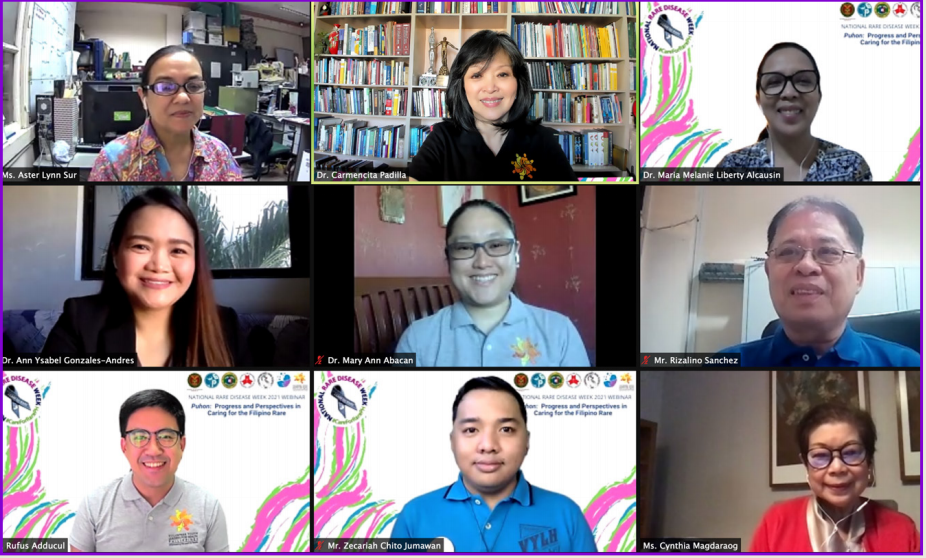
In observance of the 12th National Rare Disease Week, the Institute of Human Genetics together with the Philippine Society of Orphan Disorders and the Volunteer Youth Leaders for Health – Philippines (VYLH) launched their first webinar on rare diseases entitled “Puhon: Progress and Perspectives in Caring for the Filipino Rare” last 25 February 2021 via the Zoom webinar platform. 

The event was opened by the Director of the Institute of Human Genetics Dr. Maria Melanie Liberty Alcausin followed by an inspirational message from the Philippine Undersecretary of Health for Public Health Services, Dr. Maria Rosario Vergeire. She emphasized that all individuals including those with rare disease should have access to quality healthcare. While this is a seemingly arduous task, she believes that it is attainable but “necessitates a whole of government, a whole of system and a whole of society approach”. She ended her message with a commitment statement that “the Department of Health will continue to provide the necessary assistance in order to further the advocacy for rare diseases as it is an integral part of the overall objective of the universal healthcare to provide health services to all Filipinos.” 

Dr. Mary Ann Abacan, a clinical geneticist – metabolic specialist and one of the advisers of VYLHPhilippines, went on to discuss the basics of rare diseases. She stated that rare diseases are also called orphan disorders because they have been neglected, especially in terms of treatment, for many years. At the same time, rare disease patients suffer from social abandonment because of the lack of an existing network of support to aid them. She reiterated that treatment is available for some of the rare diseases and that everyone can take their part in advocating for public awareness. 

UP Manila Chancellor Dr. Carmencita Padilla, main proponent of the Rare Disease Act of the Philippines, discussed the existing landscape of rare diseases locally and internationally. She underscored that even with the enactment of the law, big challenges are still being faced due to the huge cost of individual care and the lack of a national program and sustainable funding. The full implementation of the law as well as the inclusion of rare disease in the Universal Health Care Law are of utmost importance in providing the needs of these patients. 

Dr. Ann Ysabelle-Andres of DOH’s Disease Prevention and Control Bureau laid out the DOH’s initiative to develop a national strategic plan on integrated rare diseases management for the period 2022-2027. This includes identification, referral, management, registration, and resource generation thereby ensuring that these patients are guaranteed equitable access to quality health care goods and services. 

The event was also graced by Mr. Rizalino Sanchez of the National Council on Disability Affairs and two parents who shared their experiences in caring for their child with a rare disease. The webinar was closed by Mrs. Cynthia Magdaraog, President of the Philippines Society for Orphan Disorders, who expressed her hope for progress with the strong partnership and renewed commitment of the government and the academe.#

Published in the UP Manila Newsletter HealthScape
Special COVID-19 Issue No. 24 (February 2021)

Published by the UP Manila - Information, Publication, and
Public Affairs Office (IPPAO)


Share:

Resilience in the time of pandemic: The experiences of NBS implementers


Newborn screening is an essential preventive public health program for the early detection of congenital disorders in newborns that may lead to mental retardation or even death if left untreated. It is performed shortly after 24 hours of the birth of the baby in hospitals, lying-ins, rural health units, health centers, and private clinics.

If screened positive in one of the disorders, the baby undergoes a confirmatory test and is subsequently followed up for management. Administration of the necessary treatment and management is the reason why newborns need to be screened immediately. Hence, the COVID-19 pandemic is a huge challenge in the provisions of newborn screening services. The lockdowns in many areas of the country, suspension of transportation services including air travels, non-operation of major couriers, and closure of borders in some provinces have posed challenges to the newborn screening program. Program implementers were faced with delays in the transmittal of newborn screening samples, significant decrease in the newborn screening sample receipt, overwhelming number of late samples, delay or cancellation of confirmatory testing, and suspended follow up visits of patients. Managing the operations at different levels was and continues to be a tough task.

To weather the storm, newborn screening program leaders quickly stepped up to respond and coordinated mitigation plans effectively and efficiently. Throughout the pandemic, all newborn screening centers (NSCs), regional newborn screening teams at the Department of Health - Centers for Health Development (CHDs), newborn screening continuity clinics (NBSCCs), and newborn screening facilities (NSFs) in the country remained operational and employed various strategies while observing standard protocols in continuously giving quality newborn screening services.

The recently concluded newborn screening virtual convention featured the best practices of some program implementers during the crisis. The Newborn Screening Reference Center keeps several stories of innovations - from the Newborn Screening Bayanihan Strategy in Northern Luzon, the active social media campaigns of Central Luzon, release of certifications for checkpoints in Southern Luzon, and extension of credit line in the Visayas, among others.

Newborn Screening Center - Mindanao

The NSC Mindanao and the CHD teams organized a system to help bridge the gaps and establish alternative plans to keep the program afloat in Mindanao.

The CHD Zamboanga formed a special task force on newborn screening. It also coordinated with the Office of City Mayor Isabelle Climaco-Salazar for the weekly transport of samples to the NSC. The Edwin Andrews Air Base and the Philippine Airforce Western Command made possible the airlifting of samples, medical milk supplies, and pertinent documents to and from Region 9 via military aircrafts.

Meanwhile, the CHD Northern Mindanao, together with city health offices and selected facilities, served as drop-off and pickup locations within the region. With lockdown protocols in place, the CHD and NSC Mindanao teams met at the border checkpoints of Davao City to turn over specimens and documents once a week. In three months’ time, Region 10 was able to deliver a total of 12,417 samples.

In Davao, many health facilities within Davao City hand carried samples to the NSC. The CHD 11 NBS team assisted these facilities using its service vehicles. A temporary delivery system was also established through the assistance of the different provincial DOH Offices. The Sta Rita Maternity Clinic, Isaac Robillo Memorial Hospital, Dr Lorenzo Principe Clinic and Malita District Hospital also volunteered as drop-off facilities.

Since vehicles were not allowed to enter Davao City, the NSC Mindanao requested the Viacrucis Medical Hospital to serve as drop-off points for Sultan Kudarat Provincial Hospital's samples. The assigned staff from both facilities met at the border of Davao del Sur and North Cotabato Province.

DOH vehicles and provincial ambulances were used to enter the border from the south. Along with provincial hospitals in Sultan Kudarat, and North and South Cotabato, they formed the backbone of the ENBS task force in the SOCCKSARGEN region.

The DOH CHD Caraga used the provincial DOH offices as drop-off and pickup locations. The NBS team of CHD Caraga and NSC Mindanao met at the northern border checkpoints of Davao City once a week.

The Maguindanao and Lanao del Sur areas of the Bangsamoro Autonomous Region in Muslim Mindanao were serviced by the CHD 9 and 12, respectively. The DOH-CHD 9 also transported samples of health facilities from Basilan and Tawi-tawi provinces. With the help of the Integrated Provincial Health Office Sulu, samples from Sulu were transported directly to Davao City courtesy of the Philippine Airforce Tactical Squadron Operations of Jolo, Sulu.

DOH Center for Health Development - Bicol

A series of consultations was held with several stakeholders, i.e. provincial health offices, city coordinators, health facilities, external partners, COVID team, and other internal stakeholders to discuss strategies to ensure the Business Continuity Plan (BCP) for the ENBS.

The CHD 5 immediately transitioned from conventional in-person activities to online orientations, meetings, trainings, advocacy activities, webinars, and other forms of technical assistance.

On the logistics side, the CHD 5 created and operationalized the timely receipt and sending of ENBS and confirmatory samples from health facilities to the NSC National Institutes of Health in Quezon City. It facilitated the delivery of kits from the NSC to the health facilities, and the delivery of essential medical supplies, foods, supplements to patients, among others.

Pira Hospital Cabugao, llocos Sur

Difficulties emerged regarding the transport of specimens and obtaining of filter kits on time from the NSC Northern Luzon in Mariano Marcos Memorial Hospital and Medical Center, Batac, llocos Norte, which is situated in another province.

Bless Macugay, chief medical technologist of Pira Hospital, goes to the border and hands over properly sealed specimens to the one manning the border from NSC. In turn, that personnel bring the specimens for testing at the NSC.

The Pira Hospital also used the acronym COVID to characterize the goals of the program - C for communication, O for obedience, V for vigilance, I for innovation and creativity, and D for diligence in performing timely screening.

Newborn Screening Continuity Clinic - Cebu

The Newborn Screening Continuity Clinic (NBSCC) is an ambulatory clinic based in a tertiary hospital identified by the DOH to be part of the National Comprehensive Newborn Screening System Treatment Network. One of the NBSCCs is located in Cebu, hosted by the Vicente Sotto Memorial Medical Center (VSMMC) serving 497 patients including those in Bohol, Dumaguete, Siquijor, and the entire Cebu Province.

Faced with challenges during the COVID pandemic, such as difficulty in recall of patients; non- compliance with follow up, treatment, and laboratory monitoring; travel restrictions; and low supply of medicines and medical food, the NBSCC in Cebu immediately transitioned to telemedicine and activated networks of referral in the region for patient monitoring. It currently uses text messaging, phone calls, and video calls through different online applications for remote patient monitoring and clinical validation together with sub-specialists (pediatric endocrinologists and metabolic specialists), and dietitian-­nutritionists. It also refers patients to the DOH-CHD, RHUs, or satellite clinics in some provinces either for follow ups or home visits.

Supply and logistics for medicines and medical food for patients were coordinated with the Institute of Human Genetics (IHG)- UP Manila, DOH-CHD 7, Office of the Civil Defense, Philippine National Police, and Philippine Air Force.

There are valuable lessons emerging from the current crisis. It has been proven time and again that collaborations among program partners, supporters, and those who lend their hand especially during the time of crisis can make a positive difference. COVID-1 9 is a threat but, at the same time, an opportunity for having efficient and effective continuity plans and creative strategies that allowed the newborn screening implementers to continue fulfilling their essential roles in ensuring the health and well-being of the most vulnerable in the populace - the newborns.#

First published on Philippine Star, October 18, 2020

MEDIA RELEASE

Newborn Screening Reference Center @newbornscreenph
National Institutes of Health - UP Manila
https://newbornscreening.ph
info@newbornscreening.ph


Share:

Navigating the path towards a successful ENBS amidst challenges


"The pandemic has disrupted our usual protocols and systems, but the poorest and most vulnerable feel the inequalities more so than others. These are mothers who have no access to quality healthcare; babies who are born in less desirable environments:' said Vice-President Maria Leonor Gerona Robredo in her keynote address during the opening of the first ever virtual National Newborn Screening Convention on October 14.

Robredo cited data from UNICEF stating that an estimated 116 million babies will be born under the shadow of the pandemic and this should not stop the new families from getting support and access to primary care.

She then challenged the participants to keep protocols and systems in place to protect not only mothers and their babies but also frontliners who are their primary caregivers; to continue expanding services that can cover indigent families; and to ensure that patients and their families are properly informed and supported when their test comes back positive. She believes that the tasks are daunting and encouraged everyone to continue to find ways to extend service and build together a better future for the next generation.

Held on October 14-15, 2020, the 18th National Newborn Screening Convention attracted over 6,000 registrants composed of health professionals, program implementers, partners, and advocates of the newborn screening program. 1his year's theme, "Navigating the Path Towards a Successful Expanded Newborn Screening Amidst Challenges" was inspired by the exemplary response of the program stakeholders to the COVID-19 pandemic. The two-day event was organized by the Newborn Screening Society of the Philippines (NSSPI) and the University of the Philippines (UP) Manila through the Newborn Screening Reference Center (NSRC).

This was the first time that the convention was held online since it started in 2001. Notwithstanding the COVID pandemic, NSSPI still aimed to provide education, technical updates, and share best practices on newborn screening operations. 1his year's convention was also in honor of the life and strong leadership of NSSPI President Dr. Ephraim Neal Orteza, who passed away last April 8 due to COVID-19. Orteza had served as president from 2015 until his death.

Overall Program Chair and NSRC Director Dr. Noel Juban welcomed the participants and presented the status of the program after the implementation of expansion in the number of disorders being screened from 6 to 29 [expanded newborn screening], its continuing challenges, and the efforts to address them. "With the present national and global situation related to the Covid-19 pandemic, we, [the] newborn screening advocates, have continued giving our services towards our goal of saving every Filipino child from mental retardation and death;' he said.

UP Manila Chancellor Dr. Carmencita Padilla, one of the conveners of the newborn screening program in the Philippines, presented the strategic framework for the implementation of the Expanded Newborn Screening (ENBS) in the country, the strategies to be undertaken to attain the targets set in the framework, and the significant roles of the different program stakeholders.

Meanwhile, the plenary sessions featured the following topics: endocrinology, metabolic, hematology, genetic counseling, nutrition, and the resilience and solidarity of the various levels of newborn screening implementers as they responded to the challenges brought about by the pandemic.

In the plenary session on endocrinology, Dr. Lorna Abad, Chair of the UP-Philippine General Hospital Department of Pediatrics, presented the basic facts on Congenital Hypothyroidism (CH). She also differentiated between transient and permanent congenital hypothyroidism. Dr. Sylvia Estrada, Chair of the Newborn Screening Expert Committee on Endocrine Disorders, shared the prevalence and importance of early detection and treatment of Congenital Adrenal Hyperplasia (CAH). She also shared the hindrances in CAH care and current efforts to lessen these such as holding regional newborn screening clinics in collaboration with the Philippine Society of Pediatric Metabolism and Endocrinology (PSPME).

With the metabolic medicine in focus, two clinical geneticists, Dr. Leniza de Castro-Hamoy and Dr. Mary Ann Abacan, presented Tyrosinemia Type I and Glutaric aciduria Type I, respectively. Both are autosomal recessive disorders of amino acid metabolism which result in primarily hepatic, but also renal, skeletal, and neurologic manifestations. They also talked about the importance of early detection, proper management to prevent life-long complications, and the need to continue advocating for patients with rare diseases to make sure that treatment and medications become more accessible to the patients.

Day 1 ended with a plenary session focusing on Hemoglobinopathies. Drs. Maria Beatriz Gepte and Reynaldo de Castro, both hematologists from the Philippine Children's Medical Center (PCMC), correspondingly presented the prevalence in areas endemic to malaria of Alpha Thalassemia where the more severe forms are present, and the challenges of blood transfusion in Beta Thalassemia. Gepte highlighted the importance of physician, community education, and genetic counseling to prevent long term complications, development of more severe disease, and further perpetuation of alpha thalassemia in the population. De Castro on the other hand, emphasized significant health concerns as well as the economic impact of beta thalassemia.

Day 2 of the convention started with a plenary session that focused on the importance of evaluating and understanding a family's risk of an inherited medical condition through genetic counseling. Genetic counselors Dr. Ma-Am Joy Tumulak, Angela Pascua, and Peter James Abad emphasized the value of information and support to families affected by or at risk of a genetic disorder. Tumulak stressed the importance of a multidisciplinary team of doctors, nurses, social workers, therapists, and genetic counselors in the holistic management of the patients. She mentioned the role of genetic counselors in providing a unique opportunity for the family to receive continuous support, information, and continuity of care. Pascua cited that genetic counseling will help replace misconceptions about the causes of genetic diseases and promote psychological well­being and adaptation to the genetic condition or risk, specifically in hemoglobinopathies. Abad, on the other hand, focused on the crucial phase of disclosing the bad news and how primary care providers can best approach the relaying of information to families in a sensitive, respectful, and empathic manner.

The plenary session on nutrition featured practitioners of metabolic dietetics and developmental pediatrics. Aster Lynn Sur, dietician and metabolic nurse, discussed the history of metabolic dietetics and the critical role of dietitians in the management of patients with inborn error of metabolism (IEM). She mentioned the challenges faced by metabolic dietetics, including professional standards, development of outcome-based treatment guidelines and protocols, research and development, and local and international collaboration, among others. Jeanne Ruth Basas, metabolic dietician, tackled the challenge of IEM dietary management during the time of the pandemic. She specified difficulties in securing adherence to patients' nutritional management, transition from face to face consultation to telemedicine, and procurement of food and medicines for patients. Dr. Kaye Napalinga, developmental and behavioral pediatrician, discussed the techniques in improving the feeding experience of the child. She emphasized that feeding infants and young children not only ensures physical growth but shapes their emotional and social development.

In the last plenary session, four program implementers presented how they provided the newborn screening services amidst the challenges brought about by COVID-19. They shared what drove them to continue implementing newborn screening and how they responded to the challenge from collection to transmission, to testing and management of positive patients. It also featured how the DOH Center for Health Development responded to lessen the operational gap in the provision of newborn screening services in the region. Dr. Conchita Abarquez, Head of lhe Newborn Screening Center-Mindanao, Dr. Ma. Rita Anne Salve Boligao, Follow-up Head of the Newborn Screening (NBS) Continuity Clinic in Vicente Sotto Memorial Medical Center (Cebu), Dr. Monrey Isaiah Mancilla, Newborn Screening Program Manager of Bicol Center for Health Development, DOH, and Dr. Maria Alejandra Narcelles, NBS Coordinator of Pira General Hospital, Cabugao, Ilocos Sur, shared how the significant disruption of the operations of newborn screening required each of them lo adapt lo adversity and maintain resiliency during the pandemic.

The National Newborn Screening Convention, held every year in October, convenes participants from different health professions to learn from local and international experts, program consultants, and program implementers. The theme constantly follows the theme of the Newborn Screening Awareness Week Celebration every first week of October in accordance with Presidential Proclamation No. 540 issued by then President Gloria Macapagal on January 20, 2004.

First published on Philippine Star, October 18, 2020

MEDIA RELEASE

Newborn Screening Reference Center @newbornscreenph
National Institutes of Health - UP Manila
https://newbornscreening.ph
info@newbornscreening.ph

Share:

Facebook

Twitter

Recent Posts

Recent Posts Widget